
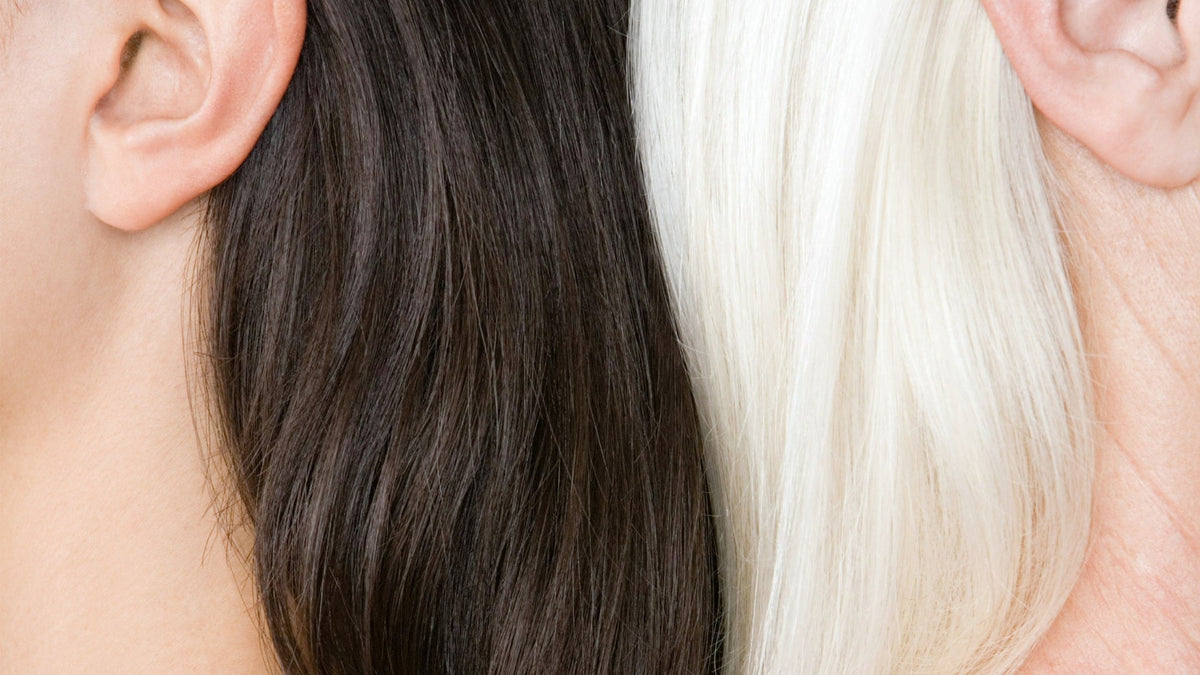
Thinning Hair After 40: Causes, Care and Realistic Expectations
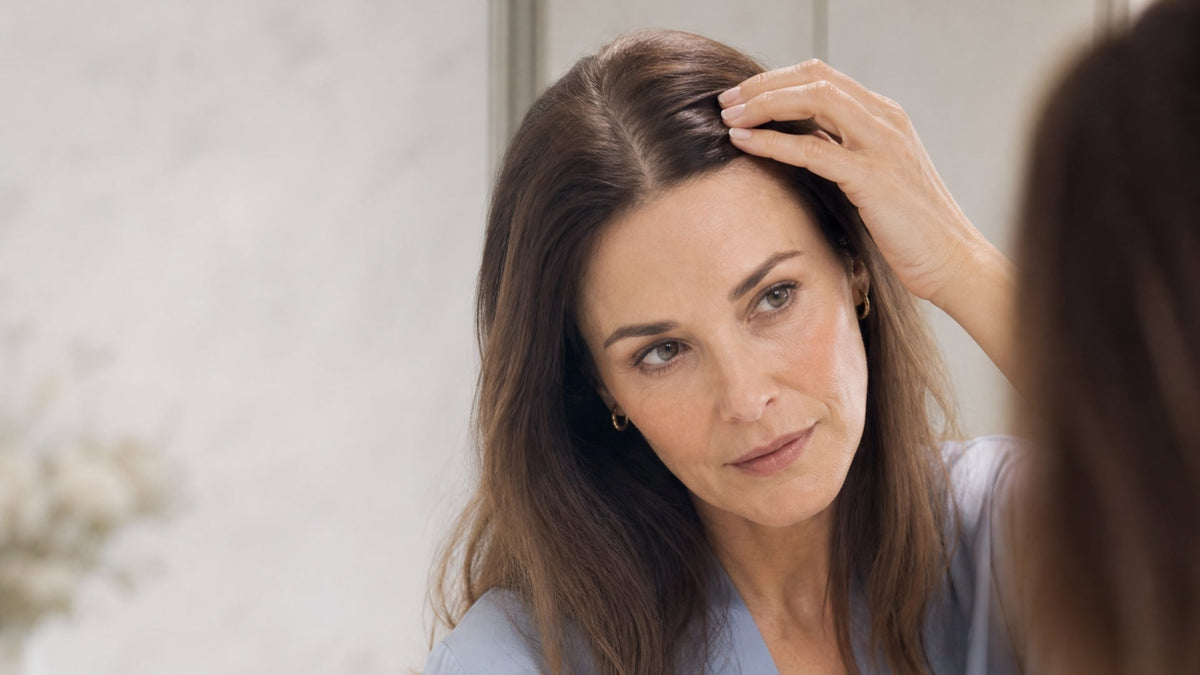
Your part looks wider. Your ponytail feels thinner. More hair seems to be collecting in the brush or shower. Many women start noticing changes like these after 40.
Menopause often gets the blame straight away. Hormones can certainly affect the hair, but they are not the only possible cause. Hair loss in women over 40 can also be linked to stress, low iron, thyroid problems, certain health conditions or genetics. Sometimes more than one factor is involved.
Start by looking at what has actually changed. Are you shedding more hair? Is new hair growing back finer? Or are the lengths breaking? These problems can look similar, but they do not have the same causes.
Whatever the trigger, regular scalp care can be a useful part of your routine. It cannot treat an illness, but it can support the place where thinning becomes visible: the scalp and the hair growing from it. You do not need to wait until every possible cause has been investigated before starting good daily care.
In short: Thinning hair after 40 may be linked to hormonal changes, genetics, stress, nutritional deficiencies or thyroid problems. Targeted daily scalp care can help reduce visible shedding and support fuller-looking, stronger-feeling hair. Allow at least 12 weeks before assessing the first results.
Why can hair become thinner after 40?
Hair grows slowly and in several stages. After a long growth phase, each hair enters a resting phase. It then sheds, allowing a new hair to grow.
This is why a trigger does not always cause immediate hair loss. An illness, a very stressful period or rapid weight loss in spring may not lead to visible shedding until summer.
Age can bring other changes too. Individual hairs may become finer or stop growing as long as they once did. Colouring, heat and daily styling can make breakage more noticeable. The scalp may also become drier or more sensitive.
None of this means that every woman will experience hair loss after 40. It simply means that several possible causes are more likely to overlap at this stage of life.
For a broader look at how the hair follicle, scalp and hair fibre change with age, read our guide to hair longevity.
What can cause thinning hair after 40?
What role do hormonal changes play?
Perimenopause can begin years before the final period. Hormone levels fluctuate during this time, and oestrogen eventually falls. These changes may affect the hair cycle and the thickness of individual hairs.
This does not always cause sudden or heavy shedding. Many women first notice less volume, a wider part or new hair growing back finer than before.
Even so, do not assume that every hair change after 40 is caused by hormones. There may be another explanation.
For a closer look at these changes and daily care options, read our guide to hair loss during menopause.
Genetics
In female pattern hair loss, some follicles gradually become smaller and produce finer, shorter hairs.
Women often notice this over the top of the scalp. The part becomes wider and more scalp shows through, while the front hairline usually remains in place. This type of hair loss can begin earlier in life, but it becomes more common with age.
A dermatologist can help identify whether the pattern is genetic or caused by something else. A good daily scalp routine can continue alongside that assessment.
Can stress and nutrition affect the hair?
Severe physical or emotional stress can push many hairs into the resting phase at the same time. Common triggers include:
● a feverish illness;
● surgery;
● an intensely stressful period;
● a very restrictive diet;
● rapid weight loss.
The extra shedding often starts two or three months later, so the link can be easy to miss.
This type of diffuse shedding, called telogen effluvium, may settle over time. If it continues or keeps returning, it is worth getting medical advice.
Iron and other nutrients
The body needs enough energy, protein, vitamins and minerals to make hair. Iron status is often checked when someone has diffuse shedding.
This does not mean that everyone with thinning hair should take iron, biotin or a general hair supplement. Supplements do not fix every type of hair loss, and too much of some nutrients can be harmful.
It is better to find out whether you actually have a deficiency and only supplement what you need.
Thyroid problems, medication and health conditions
Both an underactive and an overactive thyroid can affect the hair and skin. Certain medicines, autoimmune conditions, inflammation and scalp disorders may also cause hair changes.
Tell your doctor about any other symptoms you have noticed. Fatigue, weight changes, irregular periods or new skin problems may all be relevant.
Breakage
Hair does not always become thinner because it is falling out from the root. Bleaching, frequent heat styling, tight hairstyles, extensions and rough brushing can damage the hair fibre.
When many hairs break at different lengths, the whole style loses volume. In this case, the lengths need gentler care. A scalp serum cannot repair hair that is already damaged.
Why targeted scalp care matters after 40?
Not every cause can be quickly changed. Hormonal shifts and genetic predisposition, for example, are part of an individual’s background. A well-formulated cosmetic serum still gives you something practical you can do for your scalp and hair every day.
A scalp serum stays on the skin, so it can deliver its ingredients more directly than a shampoo that is rinsed off after a short time. Depending on the formula, it may:
● care for and soothe the scalp;
● reduce dryness or feelings of tightness;
● help reduce visible hair shedding;
● support fuller- and denser-looking hair;
● help the hair feel stronger.
Many women notice several changes at once: increased shedding, reduced fullness, weaker-feeling hair and scalp discomfort. A targeted serum brings these care goals into one daily routine. If an iron deficiency or thyroid disorder is also contributing to hair loss, appropriate treatment can be combined with suitable scalp care.
If the hair loss is sudden or unusually severe, the medical cause should also be checked. Your daily cosmetic routine can usually continue alongside that process.
The WELAB BIOTECH Advanced Multi-Peptide Scalp Serum was developed for exactly this kind of daily care for thinning hair: once-daily use, a non-greasy texture and a multi-pathway approach rather than one fashionable hero ingredient.
Explore the formula and get early access
When should you see a doctor?
Ask for medical advice if:
● hair loss begins suddenly or becomes severe;
● round or clearly defined bald patches appear;
● the scalp is painful, very itchy, red or heavily flaky;
● the skin looks smooth or scarred in the affected area;
● you are also losing eyebrow or body hair;
● the part keeps getting wider;
● increased shedding continues for several months;
● you also have marked fatigue, significant weight changes or irregular periods.
Depending on your symptoms, a doctor may examine the scalp, use trichoscopy or order selected blood tests. Not everyone needs the same tests. A targeted scalp-care routine can continue while the cause is being investigated.
What do peptides do in scalp care?
Peptides are short chains of amino acids. Different peptides have different roles in cosmetic formulas. In a well-designed serum, they can be combined with plant extracts and soothing ingredients to address visible shedding, hair fullness, hair feel and scalp care together.
But the word “peptide” on a label does not tell you whether a serum is good. What matters is which peptides are used, how much is included and how the full formula is put together.
What matters is not the longest ingredient list, but how the ingredients work together in a formula that feels comfortable enough to use every day. Even the best serum can only make a difference when it is used consistently.
Why should you wait at least 12 weeks?
Hair does not respond in a few days. A hair that sheds today may have entered the resting phase several weeks ago. New hair also takes time to become visible.
That is why 12 weeks is a sensible first point to assess your routine. It is not a promise of a specific result. Depending on the cause, changes may take longer.
To track your progress more clearly:
1. Use the product regularly and follow the directions.
2. Try not to start several new treatments at the same time.
3. Take a photograph of your part once a month, using the same light and angle.
4. Look at shedding, volume, hair feel and scalp comfort rather than focusing on one measure.
5. If the hair loss is severe or getting worse quickly, have the cause checked while continuing your care routine.
Counting hairs every day is rarely helpful. The amount you see in the shower or brush also depends on your hair length and how often you wash and brush it. Monthly photographs usually show the bigger picture more clearly.
What does a simple daily routine look like?
● Cleanse the scalp as needed: Washing less often will not prevent hair loss caused by an internal trigger.
● Apply a scalp serum every day: A leave-on formula stays on the scalp longer than a shampoo. Give the routine at least 12 weeks before assessing it.
● Protect the lengths: Use less heat, avoid constantly tight hairstyles and brush gently.
● Use supplements for a reason: Take them when there is a clear need, not simply because the label mentions hair.
● Track the pattern: Once a month, under similar conditions.
● Check unusual hair loss: Especially if it is sudden, severe or getting worse quickly.
Why did WELAB BIOTECH choose a multi-pathway approach?
WELAB BIOTECH developed the Advanced Multi-Peptide Scalp Serum specifically for thinning hair and daily scalp care. The lightweight, non-greasy formula combines Capixyl®, AnaGain™, copper peptide and ectoin with other plant extracts and biotechnology-derived active ingredients.
It helps reduce visible hair shedding, supports fuller- and denser-looking hair, helps the hair feel stronger and cares for the scalp.
In a 12-week application test with 20 participants, 95% said they noticed less hair loss and that their hair felt stronger. 90% reported fuller-looking hair and more volume. 85% noticed an improvement in scalp condition.*
Apply the serum directly to the scalp once a day using the pipette. The fast-absorbing texture is non-greasy and easy to add to a daily routine. Use it consistently for at least 12 weeks before making a first assessment.
Learn more about the serum and get early access
*Participant self-assessment after 12 weeks, n = 20. Individual results may vary.
Frequently asked questions
Is thinning hair after 40 normal?
Changes in hair density and texture become more common with age. However, sudden, severe or progressive hair loss should not simply be dismissed as ageing.
What helps with hair loss in women over 40?
A consistent scalp-care routine with a suitable leave-on serum is a useful first step. It can help reduce visible shedding and support fuller-looking, stronger-feeling hair. If a deficiency, thyroid problem or medical form of hair loss is also present, that cause should be treated as well.
Is menopause always the cause?
No. Hormones may play a part, but genetics, stress, illness, medication, rapid weight loss, nutritional deficiencies and breakage are also possible causes.
Should I take biotin or iron?
Not without a clear reason. Supplements are most useful when a deficiency has been identified or a healthcare professional recommends them.
When might I see a change?
You cannot judge a scalp serum after a few days. Twelve weeks is a useful first checkpoint. Some changes take longer, and results vary from person to person.
Note
This article is for general information only and does not replace medical advice, diagnosis or treatment. Please speak to a healthcare professional if hair loss is sudden, severe, inflammatory or persistent.
About the author
Alena Weissenbaeck is the founder of WELAB BIOTECH and a certified Hair Practitioner (IAT). Her work focuses on biotechnology-based scalp care, and she is currently continuing her education in trichology.
Sources and further reading
1. Gupta AK, Talukder M, Bamimore MA. Menopause and hair loss in women: Exploring the hormonal transition. Maturitas. 2025;194:108207. https://pubmed.ncbi.nlm.nih.gov/40318238/
2. Zouboulis CC et al. Skin, hair and beyond: the impact of menopause. Climacteric. 2022;25(5):434–442. https://pubmed.ncbi.nlm.nih.gov/35377827/
3. Ramos PM, Miot HA. Female-pattern hair loss: therapeutic update. Anais Brasileiros de Dermatologia. 2023;98(4):506–519. https://pubmed.ncbi.nlm.nih.gov/37003900/
4. Wolff H, Fischer TW, Blume-Peytavi U. The Diagnosis and Treatment of Hair and Scalp Diseases. Deutsches Ärzteblatt International. 2016;113:377–386. https://pubmed.ncbi.nlm.nih.gov/27504707/
5. Almohanna HM, Ahmed AA, Tsatalis JP, Tosti A. The Role of Vitamins and Minerals in Hair Loss: A Review. Dermatology and Therapy. 2019;9:51–70. https://pubmed.ncbi.nlm.nih.gov/30547302/
6. Malkud S. Telogen Effluvium: A Review. Journal of Clinical and Diagnostic Research. 2015;9(9):WE01–WE03. https://pubmed.ncbi.nlm.nih.gov/26500992/



Leave a comment
This site is protected by hCaptcha and the hCaptcha Privacy Policy and Terms of Service apply.