
Hair Longevity: What It Means and How to Support Hair as You Age
For decades, hair care focused mainly on what could be seen above the scalp: shine, smoothness, volume and damage repair.
Today, the conversation is changing.
A growing field known as hair longevity looks beyond temporary cosmetic improvement. It asks a broader question:
How can we support the scalp, hair follicle and hair fibre so that they remain functional, resilient and visibly healthy for as long as possible?
Hair longevity does not mean stopping biological ageing. It does not mean that a cosmetic product can override genetics, hormonal changes or a medical form of hair loss.
Instead, it is a long-term, preventive approach to preserving the conditions associated with healthy-looking hair: a balanced scalp environment, a well-functioning growth cycle, resilient follicles and hair fibres protected from avoidable damage.
What Is Hair Longevity?
Hair longevity is a multifactorial concept involving:
- hair-follicle activity;
- the hair growth cycle;
- scalp health and barrier function;
- hair density and fibre diameter;
- hair strength and resistance to breakage;
- pigmentation;
- environmental exposure;
- nutrition, health, stress and lifestyle factors.
In other words, hair longevity is not simply about making hair grow faster.
It is about supporting hair so that it can remain stronger, fuller-looking and resilient over time.
A 2025 scientific review described hair longevity as a holistic framework connecting hair-cycle biology, scalp care, nutrition, lifestyle, fibre quality and general health. The authors also noted that the quality of evidence varies significantly between different interventions.
This distinction matters.
Hair longevity is a useful scientific direction, but it should not become another vague beauty claim or a new way to promise that hair ageing can be “reversed.”
At WELAB BIOTECH, we see hair longevity as a framework for making better formulation and care decisions, not as permission to make unrealistic promises.
How Hair Changes with Age
Hair ageing affects both the living follicle beneath the skin and the visible hair fibre above it. These processes are connected, but they are not identical.
Changes inside the hair follicle
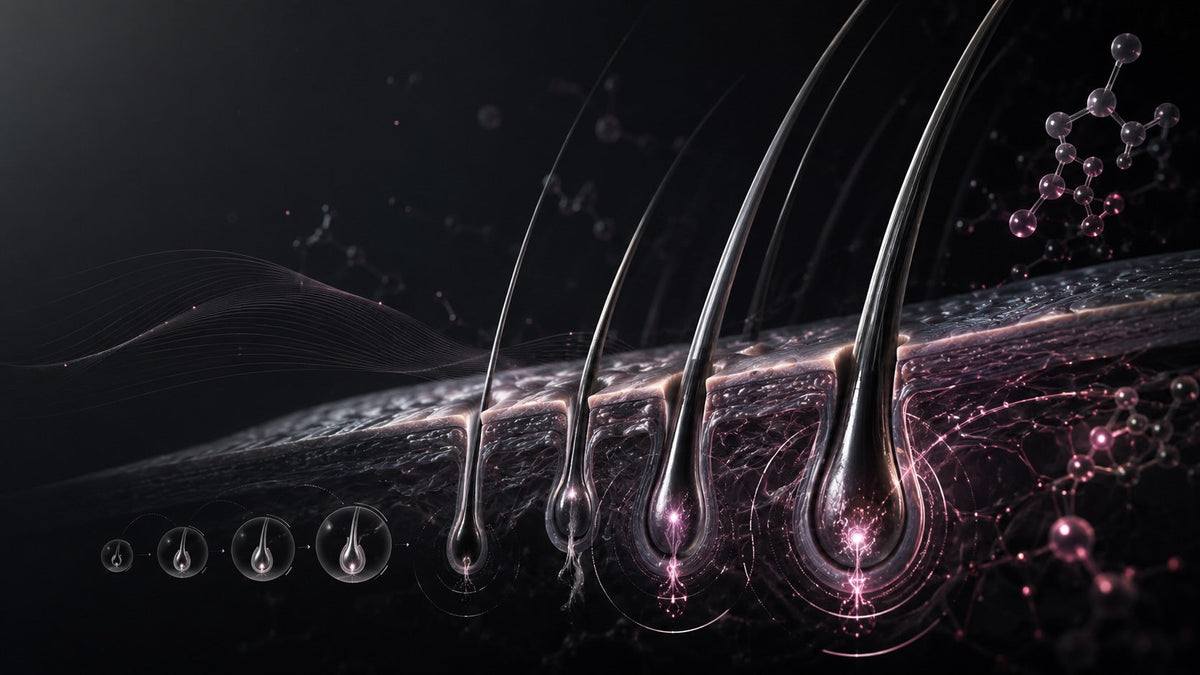
The hair follicle is a miniature organ that repeatedly moves through phases of growth, transition, rest and shedding.
During the anagen phase, cells inside the follicle actively produce the hair fibre. Anagen is followed by a short regression phase known as catagen and then by the resting phase, telogen. Eventually, the old hair is released and a new cycle can begin.
As we age, the follicle may become less productive.
Possible changes include:
- shorter or less productive growth phases;
- gradual follicular miniaturisation;
- reduced average hair-fibre diameter;
- fewer visible hairs within some follicular units;
- changes in the activity of follicular stem and progenitor cells;
- altered communication between dermal papilla cells and surrounding follicular cells;
- increasing influence from oxidative stress, inflammation and hormonal changes.
A 2026 European expert consensus described hair ageing as a combination of quantitative and qualitative changes, including pigment loss, follicular miniaturisation, declining density and deterioration in hair-fibre quality.
Hair ageing can also overlap with androgenetic alopecia and other forms of hair loss. This is why noticeable or progressive thinning should not automatically be dismissed as “normal ageing.”
Changes in the visible hair fibre
The hair fibre above the scalp is no longer biologically active.
Once it has been produced, it cannot repair itself in the same way living skin can. Repeated exposure to ultraviolet radiation, bleaching, colouring, heat, friction and aggressive grooming gradually accumulates.
Visible changes may include:
- reduced shine;
- dryness and roughness;
- increased fragility;
- breakage;
- altered texture;
- reduced manageability;
- pigment loss.
A complete hair-longevity strategy therefore needs to consider both sides of the system:
the follicle producing the hair and the fibre that must survive daily wear.
Why Hair Ages: A Multi-Pathway Process
There is no single pathway responsible for hair ageing.
This is one reason products built around one fashionable hero ingredient often oversimplify the problem.
As we explain in Why Most Hair Growth Products Focus on the Wrong Things, the potential value of a product depends on the complete formulation—not merely on the presence of one recognisable active.
Several interconnected biological processes are currently being investigated.
Oxidative stress
Reactive oxygen species are produced naturally during cellular metabolism. Their levels may also increase through ultraviolet exposure, pollution, smoking, inflammation and other forms of biological stress.
When reactive molecules exceed the tissue’s antioxidant defences, oxidative stress can affect cellular proteins, lipids, DNA and signalling processes.
Research suggests that excessive oxidative stress may disturb hair-follicle homeostasis and influence dermal papilla cells, follicular cycling and inflammatory signalling.
This does not mean that applying one antioxidant can prevent hair loss. It does, however, help explain why scalp resilience and protection from environmental stress are relevant to long-term hair care.
Inflammatory signalling
Inflammation is not always visible as severe redness.
Persistent low-level inflammatory signalling around the follicle may alter its surrounding environment. At the same time, obvious itching, pain, burning, scaling or redness can indicate a scalp condition that requires professional assessment.
For everyday cosmetic care, the realistic goal is not to “treat inflammation.” It is to avoid unnecessary irritation and support a comfortable, balanced scalp environment.
Dermal papilla cells and follicular communication
Dermal papilla cells are located at the base of the follicle and play an important role in regulating hair-cycle activity.
They communicate with surrounding follicular cells through a complex network of biological signals. Ageing, hormonal influences and oxidative stress may affect this communication.
This is why contemporary hair research is increasingly interested in peptides, botanical signalling compounds and biomimetic technologies.
However, activity observed in a laboratory does not automatically prove that a finished cosmetic product will produce clinical hair regrowth.
Concentration, stability, compatibility, delivery, tolerability and consistent use all affect the performance of a finished formula.
Read more about the difference between an isolated ingredient and a complete formulation in Why Hair Loss Is a Biotech Challenge.
The scalp environment
The follicle does not function in isolation.
It is surrounded by skin, extracellular matrix, blood vessels, immune cells, sebaceous glands and a complex microbial environment.
Dryness, barrier disruption, excessive oil accumulation, irritation and product buildup can all affect scalp comfort. Certain scalp disorders may also contribute to shedding, inflammation or breakage and need medical treatment.
Hair longevity therefore begins with a simple principle:
The scalp should be treated as living skin, not merely as the surface beneath the hair.
What Hair Longevity Means for Your Daily Routine
Hair longevity brings together scalp care and the long-term maintenance of healthy, strong-looking hair. It includes balanced scalp care, protecting the hair lengths from avoidable damage and following a consistent routine suited to individual needs.
A targeted scalp serum can bring several care goals together: hydrating the scalp, helping reduce visible shedding and supporting fuller-looking hair. The complete formulation, its tolerability and the evidence available for the finished product all matter.
If changes in hair fullness or scalp condition persist, early professional assessment can help identify possible causes and guide appropriate treatment alongside daily care. Hair longevity provides a practical framework for thoughtful, long-term hair care.
Five Foundations of a Hair-Longevity Routine
1. Do not assume every change is caused by ageing
Not all thinning is age-related.
Hair shedding and reduced density may be associated with androgenetic alopecia, illness, thyroid disorders, nutritional deficiencies, rapid weight loss, medication, postpartum changes, menopause, severe stress or inflammatory scalp conditions.
If you are noticing a wider part, reduced volume or increased shedding after 40, read our guide to thinning hair after 40.
Professional assessment is particularly important when hair loss is:
- sudden or rapidly progressive;
- patchy;
- accompanied by scalp pain, redness or severe itching;
- associated with scarring;
- concentrated in a visibly widening parting or receding hairline;
- continuing without an obvious explanation.
Cosmetic care can support appearance and scalp condition, but it should not delay diagnosis.
2. Keep the scalp clean without over-stripping it
There is no universal ideal washing frequency.
Someone with an oily scalp may need to wash more frequently than someone with a dry or sensitive scalp. The objective is to remove excess sebum, sweat, pollution and styling residue without repeatedly irritating the skin.
A clean scalp also gives a leave-on product more direct and even contact with the skin.
Aggressive scratching, frequent harsh exfoliation and uncontrolled layering of multiple active products can make the scalp less comfortable rather than healthier.
3. Use targeted scalp care consistently
Hair biology operates slowly. A product used for one week tells us very little about its long-term value.
A well-designed leave-on scalp serum can form part of a hair-longevity routine by supporting scalp comfort, hydration and the conditions associated with stronger, fuller-looking hair.
The WELAB BIOTECH Advanced Multi-Peptide Scalp Serum was developed according to a multi-pathway formulation strategy.
The formula brings together clinically studied active-ingredient systems and supportive scalp-care ingredients, including Capixyl™, AnaGain™, copper peptide, saw palmetto, ectoin, turmeric callus conditioned media, maca root extract and glycoproteins.
It was not designed around the claim that one ingredient can reverse hair ageing.
Instead, the formulation combines ingredients selected to support several factors relevant to the appearance and condition of thinning hair, including scalp balance, hair anchoring, visible shedding and the appearance of density and thickness.
Learn more about the formulation and its active ingredients on the WELAB BIOTECH Science page.
Allow at least 12 weeks before making an initial assessment. Hair-cycle changes cannot be evaluated meaningfully after only a few applications.
4. Protect the existing hair fibre
Supporting the follicle is not the only way to maintain the appearance of density.
Preventing unnecessary breakage helps preserve visible fullness, length and fibre quality.
Useful practices include:
- limiting repeated high-temperature styling;
- using appropriate heat protection;
- avoiding constant tension from tight hairstyles or extensions;
- handling wet hair gently;
- conditioning the lengths;
- reducing overlapping bleach or chemical treatments;
- protecting exposed partings and areas of reduced density from excessive sun exposure.
The visible hair fibre cannot biologically heal once it has been produced. Protection is therefore more realistic than promising complete repair.
If your main concern is already increased shedding, a widening part or declining density, read our practical guide to what a hair serum for hair loss and thinning hair can realistically do.
5. Support general health rather than chasing supplements
Hair is sensitive to changes in the body, but indiscriminate supplementation is not a hair-longevity strategy.
Protein intake, iron status, thyroid function, vitamin status, energy intake and general health may all be relevant in an appropriate clinical context.
At the same time, more is not always better. Excessive intake of certain nutrients can also be harmful.
Supplements should address an identified need rather than replace proper assessment.
Sleep, smoking, chronic stress and extreme dieting may also affect the wider biological environment in which hair grows. No single lifestyle intervention can guarantee restored density, but long-term hair care should not ignore general health.
Why Starting Early Matters
Many people begin thinking seriously about their scalp only after a significant amount of visible density has already been lost.
Hair longevity shifts the focus from crisis management to earlier observation.
Possible early changes include:
- a gradually widening parting;
- reduced ponytail volume;
- increased scalp visibility under bright light;
- hairs becoming progressively finer;
- slower recovery after a shedding episode;
- increased fragility or breakage;
- a persistent change in scalp comfort.
Starting early means noticing changes, understanding your hair’s needs and building a consistent routine. Photograph the same areas regularly, review possible triggers and choose targeted scalp care suited to your concerns.
For people without a diagnosed scalp disorder, a gentle and consistent routine is usually more rational than repeatedly switching between trending treatments.
Hair Longevity Requires Patience
Hair follows a biological timeline, not a social-media timeline.
Scalp comfort and hydration may improve relatively quickly. Changes in visible shedding, density or new growth require much longer observation.
Twelve weeks can be used as an initial evaluation period, but some changes may only become apparent after several months.
Consistency is therefore not a minor detail. It is part of whether a routine has any realistic chance of being useful.
Texture, tolerability and practicality matter because even a sophisticated product has limited value when it is unpleasant to use every day.
This philosophy is central to the WELAB approach: advanced formulation should fit into daily life rather than feel like a difficult clinical routine.
Read more in Where Science Becomes Strength: A Biotech Approach to Hair Loss.
The Future of Hair Care Is Preventive but It Must Remain Evidence-Based
Hair longevity represents a positive development in hair care.
It moves the conversation away from temporary volume and miracle ingredients toward the long-term biology of the follicle, scalp and hair fibre.
But credibility matters.
The future of hair care should be built on:
- realistic claims;
- complete formulation logic;
- relevant testing;
- transparent communication;
- recognition of medical limitations;
- routines that people can follow consistently.
That is the approach behind WELAB BIOTECH: evidence before hype, multiple pathways rather than one hero ingredient, and scalp care designed for long-term use.
Hair longevity is not the promise of ageless hair.
It is the practice of giving the scalp, follicle, growth cycle and hair fibre the best realistic conditions to remain healthy and resilient for longer.
Explore the WELAB BIOTECH formula .
Frequently Asked Questions
What does hair longevity mean?
Hair longevity is a long-term approach to supporting hair-follicle function, scalp condition, the hair growth cycle and the quality of the visible hair fibre. It focuses on maintaining function and appearance rather than promising a quick cosmetic fix.
Is hair longevity the same as hair growth?
No. Hair growth is one part of hair longevity. The wider concept also includes hair retention, scalp condition, fibre diameter, pigmentation, breakage prevention and long-term resilience.
Can hair ageing be reversed?
Some changes associated with hair ageing may be modifiable, particularly when avoidable damage or an underlying cause is identified early. However, no cosmetic product has been proven to reverse the biological ageing of all hair follicles.
When should I seek professional advice about thinning hair?
Professional assessment is appropriate when hair loss is sudden, rapidly progressive, patchy, painful, accompanied by inflammation or continuing without an obvious explanation.
How long should I follow a hair-longevity routine?
Hair-longevity care is not a short course. Scalp and fibre protection should be treated as an ongoing routine. When evaluating a leave-on scalp product, allow at least 12 weeks for an initial assessment and recognise that meaningful changes may require several months.
About the Author
Alena Weissenbaeck is the founder of WELAB BIOTECH, an Austrian science-led hair and scalp care company.
She holds a Hair Practitioner Certificate from the International Association of Trichologists (IAT) and writes about hair-follicle biology, scalp care, cosmetic active ingredients and responsible product development.
Her work focuses on translating scientific research into practical, evidence-led cosmetic formulations. She does not provide medical diagnosis or treatment.
Scientific References
- Westgate GE, et al. Hair Longevity—Evidence for a Multifactorial Holistic Approach to Managing Hair Aging Changes. Journal of Clinical Medicine. 2025.
Read the study on PubMed - Saceda-Corralo D, et al. Hair Aging Revisited: An Expert Delphi Consensus on Pathogenesis, Clinical Features, and Future Therapies. Dermatology and Therapy. 2026.
Read the expert consensus on PubMed - Du F, et al. Oxidative Stress in Hair Follicle Development and Hair Growth. Journal of Cellular and Molecular Medicine. 2024.
Read the full paper - Liang A, et al. Signaling Pathways in Hair Aging. Frontiers in Cell and Developmental Biology. 2023.
Read the paper on PubMed
This article is provided for educational purposes and does not replace medical diagnosis or treatment.



Leave a comment
This site is protected by hCaptcha and the hCaptcha Privacy Policy and Terms of Service apply.