
Article: Hair Loss During Menopause: Causes and What You Can Do

Hair Loss During Menopause: Causes and What You Can Do
Updated: 10 October 2026
By Alena Weissenbaeck, founder of WELAB BIOTECH and holder of a Hair Practitioner Certificate from the International Association of Trichologists (IAT).
Hair loss during menopause can be linked to hormonal changes, but genetics, iron deficiency, thyroid problems and significant weight loss may also contribute. What helps starts with understanding the change: are more hairs suddenly shedding, or is your hair gradually becoming finer? The next step is to investigate possible causes and build a manageable routine: eat adequately, handle your hair gently and care for your scalp. Depending on its formulation and evidence, a cosmetic scalp serum can support reduced visible shedding and fuller-looking hair. Persistent or unusual hair loss also needs medical assessment. Changes take months, not days. (bad.org.uk, bad.org.uk, welabbiotech.com)
Why does hair become thinner during menopause?
Hormonal changes can contribute to changes in your hair, but they are not automatically the only cause.
Hormone production changes during the menopausal transition, and oestrogen levels eventually decline. Age and an inherited tendency towards thinning may also become more noticeable. A smaller ponytail therefore does not necessarily mean that you simply “need more oestrogen”. Female hair loss is more complex than that. (academic.oup.com)
Three terms help explain the timeline:
- Perimenopause is the transition around your final menstrual period, when cycles can become irregular.
- Menopause is your final menstrual period, confirmed retrospectively after 12 months without a period when there is no other cause.
- Postmenopause is the stage of life afterwards. (who.int)
In one study of 178 postmenopausal women, researchers identified female pattern hair loss in around half of those examined. This shows how common the concern can be—not that one in two women will inevitably experience it, or that hormones alone are responsible. (pubmed.ncbi.nlm.nih.gov)
Our guide to thinning hair after 40 explores other possible influences.
More hair in the brush or a wider parting: what is the difference?
Sudden shedding and gradual thinning are different changes, although they can happen together.
With telogen effluvium, more hairs than usual enter the resting phase and shed later. Diffuse hair loss means shedding across the scalp rather than in one distinct area.
With female pattern hair loss, affected hairs gradually become finer and shorter. This process is called miniaturisation. A hair follicle is the structure within the skin where a hair grows. (bad.org.uk, bad.org.uk)
|
What you notice |
What it could suggest |
A useful next step |
|---|---|---|
|
Suddenly finding much more hair when washing or brushing |
Temporary diffuse shedding, possibly following illness or significant weight loss |
Review potential triggers over the preceding months |
|
A gradually widening parting and less fullness over the crown |
Female pattern hair loss |
Have a dermatologist assess the pattern and hair thickness |
|
A receding frontal hairline, sometimes with thinning eyebrows |
An inflammatory, scarring form of hair loss, among other possibilities |
Arrange a prompt dermatology assessment |
This comparison offers guidance, not a diagnosis. The last pattern should not simply be dismissed as normal ageing. (bad.org.uk, bad.org.uk, bad.org.uk)
What can you do in practice?
The most useful approach is to investigate possible causes while building a simple, well-tolerated care routine.
1. Look at the timeline
When did the change begin? Was there an illness, a medication change or significant weight loss beforehand? With diffuse shedding, the trigger often occurred around three months earlier. Depending on your history, tests for iron deficiency or thyroid problems may be appropriate. (bad.org.uk)
If your weight has changed, read our article on Ozempic, weight loss and hair shedding.
2. Do not replace nutrition with “hair vitamins”
Whether you need a supplement depends on your diet and, where appropriate, test results. Supplements are not a universal solution for hair loss. (academic.oup.com)
3. Be gentle with the hair you have
Reduce excessive heat, detangle carefully and avoid hairstyles that constantly pull on the roots. These habits cannot correct an internal cause, but they help limit additional stress on your hair. (bad.org.uk)
4. Choose a routine that fits your day
Keep the routine manageable rather than starting several new products together. Record when you begin and take comparable photographs each month. This makes changes easier to assess.
How can a scalp serum help during menopause?
A suitable serum can care for the scalp and support the appearance of thinning hair. The complete formula, tolerability and evidence for the finished product matter.
A leave-in scalp serum is applied directly to the scalp and is not rinsed out. Unlike a product for the lengths, it focuses on the skin from which your hair grows.
Different ingredients have different roles in scalp care. Peptides and botanical extracts such as AnaGain™ are used in formulas designed to support fuller-looking hair, while ectoin helps the skin retain moisture and supports its protective barrier. Combining these roles means a serum can address both the appearance of thinning hair and scalp comfort—two considerations when choosing a daily routine.
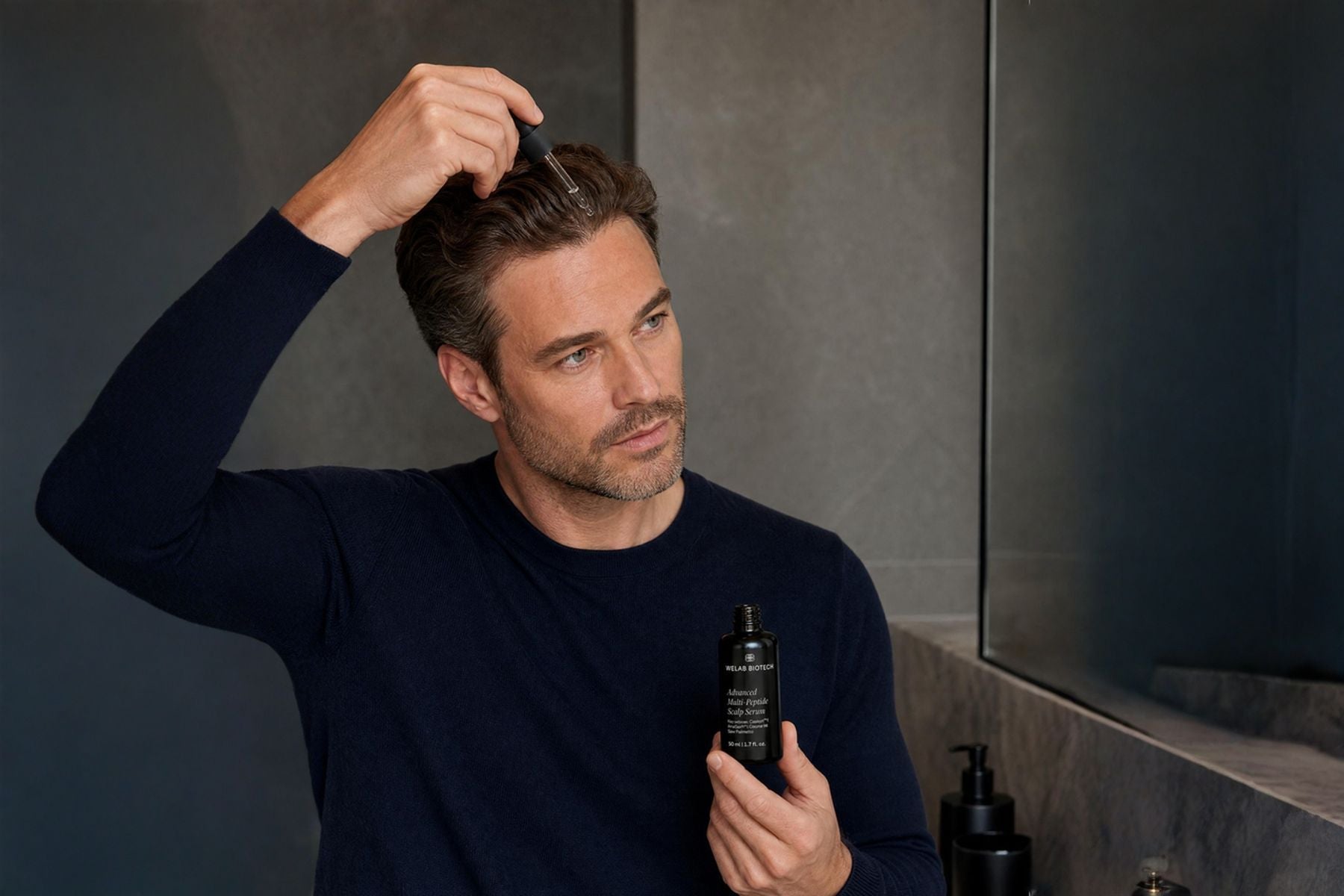
The WELAB BIOTECH Advanced Multi-Peptide Scalp Serum brings these roles together in a lightweight, non-greasy formula developed to help reduce visible shedding, support fuller-looking hair and care for the scalp.
In a 12-week consumer study involving 20 participants*:
- 95% reported reduced hair loss.
- 90% reported fuller-looking hair.
- 85% reported visible new “baby hairs”.
For more context, read what a hair serum can and cannot do and our guide to peptides for hair loss.
What does a simple daily routine look like?
WELAB is designed for once-daily use. A consistent routine is easier to assess than frequent product switching.
Create four or five partings and apply a total of 1–2 ml directly to the scalp. Massage gently and leave it in. Choose morning or evening—whichever you can maintain comfortably.
The consumer study ran for 12 weeks. This provides an initial reference point for assessing the cosmetic routine, not a guarantee of a particular result. Stop using the product if irritation occurs. (welabbiotech.com)
When might your hair look fuller again?
Less shedding and more visible fullness are separate improvements. Fullness usually takes longer.
Temporary telogen effluvium may settle within three to six months, while fuller-looking hair can take additional months to return. Female pattern thinning generally needs longer-term management. (bad.org.uk, bad.org.uk)
For photographs, keep your parting, lighting, distance and hair condition as consistent as possible. A monthly comparison is more useful than checking the mirror every day.
When is scalp care alone not enough?
Progressive hair loss, a receding hairline, thinning eyebrows, burning or redness should be assessed by a healthcare professional.
Inflammatory, scarring forms of hair loss can permanently damage follicles, so early assessment matters. If a medical condition or deficiency is identified, it needs appropriate treatment; cosmetic scalp care plays a complementary role. (bad.org.uk, bad.org.uk)
The practical approach is straightforward: understand what is changing, address possible causes and build a care routine you can maintain.
Sources
- Chaikittisilpa S. et al. (2022). Prevalence of female pattern hair loss in postmenopausal women: a cross-sectional study. Menopause. Primary research.
- Multidisciplinary Androgen Excess and PCOS Committee (2019). Female Pattern Hair Loss and Androgen Excess. Clinical report.
- British Association of Dermatologists: Telogen effluvium, female pattern hair loss and frontal fibrosing alopecia.
- World Health Organization: Menopause.
- Mibelle Biochemistry: Hair Growth Stimulated by Pea Sprout Extract. Manufacturer publication on AnaGain™.
- bitop: Ectoin® Natural. Manufacturer information on skin-barrier support.
*Product data: publicly reported WELAB BIOTECH consumer study, 12 weeks, 20 participants, self-assessment. It was not measured percentage increases in hair density or specific proof of effectiveness for menopausal hair loss.
Disclosure: The author is the founder of WELAB BIOTECH. This article provides general information and does not replace medical advice, diagnosis or treatment.


Leave a comment
This site is protected by hCaptcha and the hCaptcha Privacy Policy and Terms of Service apply.